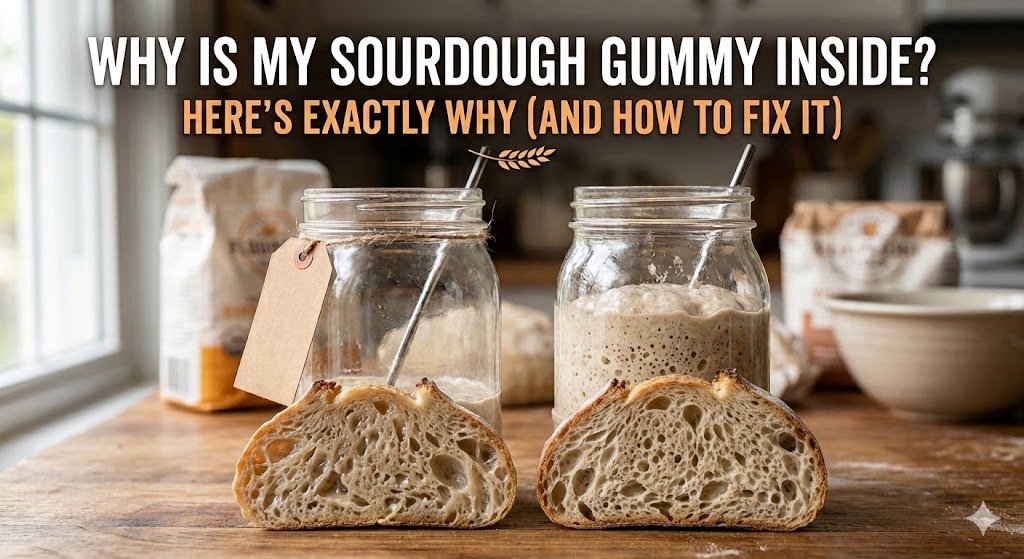
You waited all day. You scored it beautifully, baked it in your Dutch oven, and pulled out a gorgeous golden loaf. Then you cut into it — and the inside is dense, wet, and gummy. Almost like raw dough.
If your sourdough is gummy inside, you’re not alone. It’s one of the most disheartening things that can happen after hours of work. But here’s what’s important to know: a gummy crumb is always caused by something specific and correctable. Once you know why it happened, it won’t happen again.
This guide covers every common cause of gummy sourdough, how to diagnose which one is your culprit, and exactly what to change on your next bake.
What Does “Gummy” Actually Mean?
It helps to be precise, because “gummy” can mean a couple of different things:
- Gummy and dense — the crumb is tight, heavy, slightly wet, and sticks to the knife when you cut it
- Gummy with big holes — the crumb is open but the walls between the holes feel damp and undercooked
- Gummy just in the center — the outer inch of crumb is fine but the middle is underdone
Each of these points to slightly different causes, but most of the reasons below apply across all three. Start at the top of the list — the most common culprits are first.
Quick Diagnosis Table
| What You See | Most Likely Cause |
|---|---|
| Dense, wet, heavy crumb throughout | Underbaked, underproofed, or cut too soon |
| Gummy center, fine edges | Underbaked — needs more time or higher temp |
| Wet crumb with big irregular holes | Overproofed |
| Gummy and flat loaf | Underproofed or weak starter |
| Gummy every time, no matter what | Dough too wet (high hydration) or wrong flour |
6 Reasons Your Sourdough Is Gummy Inside
1. You Cut It Too Soon (The Most Common Mistake)
This is the number one cause of gummy sourdough — and it has nothing to do with your baking technique. It’s about what happens after the loaf comes out of the oven.
When sourdough finishes baking, the internal structure is still setting. Steam is trapped inside, the crumb is still gelatinized and soft, and the starches are still stabilizing. If you cut into the loaf within the first hour (or even two hours), that steam releases all at once and the crumb turns gummy and wet.
The fix:
- Wait at least 1–2 hours before cutting. For larger loaves, 3–4 hours is even better.
- If you absolutely cannot wait, cut from the bottom — the base cools and sets faster than the top.
- Let the loaf rest on a wire rack so air circulates underneath and it cools evenly.
This single change fixes gummy sourdough for a huge number of bakers. If you haven’t tried waiting, try it before anything else.
2. It’s Underbaked
The second most common cause. Sourdough needs to reach an internal temperature of 205–210°F (96–99°C) for the starches to fully gelatinize and the crumb to set properly. If the outside is dark but the inside is gummy, the loaf looked done before it was done.
A thick crust can fool you — the outside browns quickly while the inside is still wet.
Signs your bread is underbaked:
- The bottom sounds hollow when tapped, but the loaf feels heavy
- The crust softens quickly after coming out of the oven
- The internal temperature is below 205°F
The fix:
- Use an instant-read thermometer. Pull the loaf only when the internal temp hits 205–210°F.
- After removing the Dutch oven lid, bake uncovered for an additional 10–15 minutes to finish the crust and drive off more moisture.
- If the crust is browning too fast before the inside is done, lower your oven temp by 25°F and bake longer.
3. It’s Underproofed
Underproofing means the dough didn’t ferment long enough before baking. An underproofed loaf goes into the oven with the gluten network still tight and undeveloped, which traps excess moisture and prevents the crumb from opening up properly — resulting in a dense, gummy interior.
Signs of underproofing:
- The loaf doesn’t spring up much in the oven (“oven spring”)
- The crumb is very tight and compact, especially near the bottom
- The crust may burst open in an unscored spot because the dough was still expanding rapidly
The fix:
- Do the poke test before baking: poke the shaped dough with a floured finger. If it springs back immediately, it needs more time. If it springs back slowly and leaves a slight indent, it’s ready.
- Don’t rush the cold proof (retard) — overnight in the fridge (8–16 hours) is usually ideal.
- Make sure your starter was truly active and at peak when you mixed the dough.
4. It’s Overproofed
Overproofing is the opposite problem, but it can also produce a gummy crumb — though for different reasons. When dough ferments too long, the gluten structure breaks down and can no longer hold the gas produced during baking. The loaf collapses, and the crumb becomes dense and wet in different areas.
Overproofed sourdough often has a distinctive gumminess with large, irregular holes — the structure is inconsistent rather than uniformly tight.
Signs of overproofing:
- The dough feels very slack and jiggly when you handle it
- It spreads sideways instead of holding its shape
- Big irregular air pockets in some areas, dense gummy spots in others
- Sour, almost alcoholic smell
The fix:
- Shorten your bulk fermentation time. Bulk ferment should end when the dough has grown 50–75%, not doubled.
- In summer or warm kitchens, fermentation happens much faster — adjust timing seasonally.
- Use the cold retard (fridge overnight) to slow down the final proof and give you more control.
5. The Dough Was Too Wet (High Hydration)
High-hydration doughs (above 75%) are more prone to a gummy crumb, especially for newer bakers. More water means more steam trapped in the loaf and less structure to support the crumb. If you’re following a 80%+ hydration recipe and consistently getting a gummy result, the hydration may simply be too high for your flour or your current skill level.
Different flours also absorb water differently — bread flour absorbs significantly more than all-purpose, so using all-purpose in a bread flour recipe will leave you with a wetter dough than intended.
The fix:
- If you’re new to sourdough, start with a 70–75% hydration recipe and master it before going higher.
- Make sure you’re using bread flour if the recipe calls for it — don’t substitute all-purpose without reducing water.
- Try reducing water by 10–20g on your next bake and see if the crumb improves.
6. Your Oven Temperature Is Off
Most home ovens run 25–50°F cooler than their display reads, especially when they haven’t been preheated long enough. A Dutch oven takes at least 45–60 minutes to reach true baking temperature. If your oven is running cool, the loaf won’t bake properly from the start — leading to a gummy, underbaked interior even though the crust looks done.
The fix:
- Get an oven thermometer — they cost a few dollars and are one of the most useful baking tools you can own.
- Preheat your Dutch oven in the oven for at least 45–60 minutes before baking.
- If your oven runs cool, increase the baking temperature by 25°F from what the recipe states.
The Gummy Sourdough Checklist
Before your next bake, run through this:
- My starter doubled within 4–8 hours of feeding before I mixed the dough
- I bulk fermented until the dough grew 50–75% (not doubled)
- My shaped dough passed the poke test before baking
- I preheated my Dutch oven for at least 45–60 minutes
- I baked covered for 20 minutes, then uncovered for at least 20–25 more minutes
- My loaf hit 205–210°F internal temperature before I pulled it
- I let the loaf cool for at least 2 hours before cutting
If you can check every box, a gummy crumb becomes very unlikely.
Frequently Asked Questions
Can I re-bake gummy sourdough? Yes — if you catch it quickly. Wrap the cut loaf loosely in foil and put it back in a 350°F oven for 15–20 minutes. It won’t be perfect, but it can improve the texture noticeably. For a whole uncut loaf that seems underbaked, return it to the oven (no Dutch oven needed) at 375°F for 15 minutes.
Why is my sourdough gummy the next day but fine when fresh? If the crumb seems fine when warm but turns gummy after cooling, the loaf was likely slightly underbaked. The moisture that was suspended as steam while hot has nowhere to go as it cools, and it settles back into the crumb.
My sourdough is gummy even though I wait 2 hours — what’s wrong? If waiting to cut doesn’t help, focus on baking temperature and internal temp. Use a thermometer to confirm the loaf is hitting 205–210°F, and try adding 10 more minutes of uncovered baking time.
Does scoring affect a gummy crumb? Not directly — but poor scoring can cause the loaf to burst in unscored spots, which affects the oven spring and can lead to an uneven, denser crumb. Score confidently and decisively, at a 30–45 degree angle.
Is a slightly gummy crumb normal for sourdough? A very open, custardy crumb in a high-hydration loaf can feel slightly soft — that’s different from gummy. True gumminess is when the crumb feels wet, dense, or sticks to your knife. A well-baked sourdough should feel springy and light, even if the crumb is moist.
Bottom Line
Gummy sourdough almost always comes down to one of three things: cutting too soon, underbaking, or proofing issues. Start with the simplest fix first — give your next loaf at least two hours to cool before you cut it, and use a thermometer to confirm it’s fully baked. Those two changes alone solve the problem for most bakers.
Sourdough has a lot of variables, but once you understand what causes a gummy crumb, you’ll bake with a lot more confidence.
Struggling with your starter before you even get to baking? Read our guide: Sourdough Starter Not Rising? Here’s Exactly Why (And How to Fix It)
Ready to bake? Try our Easy Sourdough Recipe With Starter — a reliable beginner loaf designed to give you a great crumb every time.
If your loaf is coming out flat with no oven spring, the fix is usually simpler than you think. This guide covers every cause — from starter strength to Dutch oven temp — with a checklist to nail it next time. Sourdough Not Rising in the Oven?