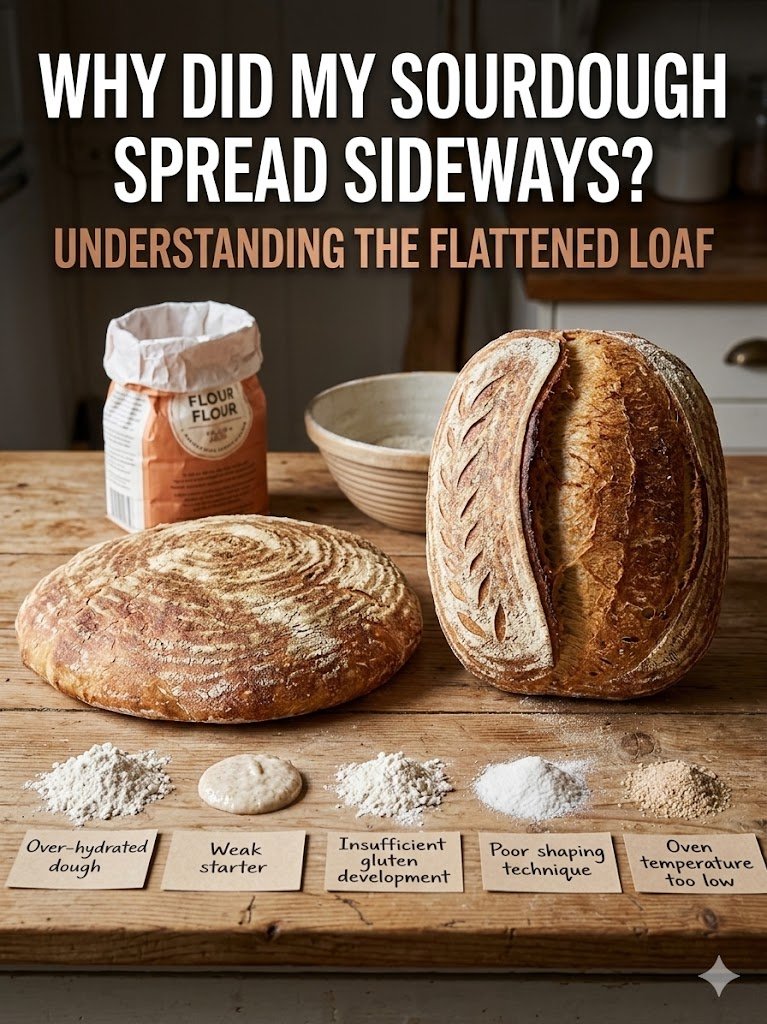
You shaped your loaf, it looked great going into the oven — and then it baked into a wide, flat pancake instead of a tall, proud loaf. If your sourdough is spreading sideways instead of rising up, you’re dealing with one of the most frustrating problems in sourdough baking.
The good news: sideways spread is almost always caused by something specific and correctable. This guide walks through every reason sourdough spreads flat, how to figure out which one is yours, and exactly what to do differently next time.
Why Does Sourdough Spread Sideways Instead of Rising Up?
Sourdough holds its shape during baking because of two things working together: gluten structure (which gives the dough strength and tension) and fermentation balance (which fills that structure with gas at the right pace). When either of these breaks down, the dough can’t support its own weight and collapses outward under the heat.
Quick Diagnosis Table
| What You See | Most Likely Cause |
|---|---|
| Spreads wide in the oven, flat crumb | Overproofed |
| Spreads during shaping, hard to work with | Weak gluten / under-developed dough |
| Holds shape going in, flattens while baking | Overproofed or too wet |
| Spreads every time regardless of recipe | Flour too low in protein |
| Recently started spreading, used to be fine | Temperature change or starter issue |
| Spreads sideways AND has a gummy crumb | Overproofed or very high hydration |
7 Reasons Your Sourdough Is Spreading Sideways
1. The Dough Is Overproofed
This is the most common reason sourdough spreads sideways, and it’s worth understanding why. As dough ferments, the yeast produces gas and the gluten network gradually weakens under the strain of holding all that gas. At some point, the gluten becomes too degraded to hold the loaf’s shape — and when heat hits it in the oven, instead of rising up, it collapses outward.
Overproofed dough is sneaky. It can look and feel wonderful — pillowy, airy, beautifully domed. Then it bakes flat.
Signs of overproofing:
- The dough feels very soft, slack, and almost jiggly
- It spreads noticeably when you turn it out of the banneton
- The poke test leaves an indent that never springs back
- The baked loaf is wide and flat with a dense, uneven crumb
The fix:
- End bulk fermentation earlier — at 50–75% growth, not when the dough has doubled
- In warm weather, fermentation moves much faster; shorten your timings significantly in summer
- After shaping, go straight into a cold retard (fridge overnight) rather than proofing at room temperature — this slows fermentation and gives you more control
2. Weak Gluten Development
Gluten is the structural scaffolding of your dough. If it hasn’t been developed properly during mixing and folding, it won’t have the strength to hold the dough upright during baking. Under-developed gluten tears rather than stretches, and the loaf spreads to relieve the pressure.
This is especially common when bakers skip stretch-and-fold sets during bulk fermentation, or when the dough was mixed too briefly.
Signs of weak gluten:
- The dough tears rather than stretches when you pull it
- It doesn’t hold a shape after shaping — it slowly relaxes and flattens
- The surface looks rough and ragged rather than smooth and taut
The fix:
- Perform 4–6 sets of stretch and folds during bulk fermentation, spaced 30 minutes apart
- Make sure your dough is smooth, elastic, and passes the windowpane test before shaping — stretch a small piece of dough thin enough to see light through without tearing
- Build more tension during shaping by using a bench scraper to drag the dough toward you across an unfloured surface
3. The Dough Hydration Is Too High
High-hydration doughs (above 75–78%) are naturally more prone to spreading because they’re softer and have less structural rigidity. If you’re following a recipe designed for bread flour but using all-purpose, the effective hydration is even higher than the recipe intends — all-purpose flour absorbs less water.
Higher hydration isn’t wrong, but it requires stronger gluten development and more precise proofing to hold shape. For beginners, it’s a common source of sideways spread.
The fix:
- If you’re new to sourdough or keep getting flat loaves, reduce hydration to 70–72% and master that before going higher
- Always use the flour the recipe specifies — substituting all-purpose for bread flour effectively increases hydration
- In humid climates, you may need to reduce water slightly regardless of the recipe
4. You’re Using Low-Protein Flour
Gluten comes from protein. Bread flour typically has 12–14% protein, which gives it the strength to build a robust gluten network. All-purpose flour has 10–12%, and some all-purpose flours (particularly soft Southern brands) can be as low as 8–9% — not nearly enough to support a well-risen sourdough loaf.
If you’ve switched flour brands recently and your loaves suddenly started spreading, protein content is likely the culprit.
The fix:
- Use bread flour for the best structure, especially if you’re still developing your technique
- Check the protein content on the bag — aim for at least 12% for reliable results
- If you prefer all-purpose, choose a higher-protein brand (King Arthur all-purpose, for example, is notably higher in protein than many store brands)
5. Poor Shaping Technique
Shaping isn’t just about making the dough look nice — it’s about building surface tension. That tension acts like a skin around the loaf, holding it upright and giving it the resistance it needs to push upward rather than outward in the oven.
A loosely shaped loaf with no tension will always spread. You can feel the difference: a well-shaped loaf feels taut and bouncy on the surface; a poorly shaped one feels soft and slack.
The fix:
- Shape on an unfloured or lightly floured surface — too much flour prevents the friction needed to build tension
- Use a bench scraper to drag the dough toward you in short strokes, tucking the bottom under as you go
- After shaping, the surface should feel taut and spring back when you press it gently
- Let the dough rest (bench rest) for 20–30 minutes after pre-shaping before the final shape — this relaxes the gluten enough to shape without tearing
6. The Banneton (or Bowl) Isn’t Providing Enough Support
After shaping, your dough needs to proof in something that holds its shape — a banneton (proofing basket), a well-floured bowl, or a loaf pan. If the vessel is too large, the dough spreads to fill it. If it’s not floured well enough, the dough sticks and tears when you turn it out, destroying the surface tension you worked to build.
The fix:
- Use a banneton or bowl that fits the dough snugly — the dough should fill about two-thirds of it
- Dust the banneton generously with rice flour (which doesn’t absorb into the dough like regular flour) to prevent sticking
- When turning the dough out, do it confidently and quickly — hesitating causes sticking and deflating
7. Your Starter Is Too Weak or Overripe
A starter that’s past its peak — overripe and overly acidic — produces excess acetic and lactic acid that degrades gluten faster than healthy fermentation would. Dough made with an overripe starter weakens more quickly, proofs faster than expected, and is much more prone to spreading.
Similarly, a starter that’s genuinely weak (young, underfed, or sluggish) won’t produce enough gas for a proper rise, leading to a dense, flat loaf for the opposite reason.
The fix:
- Use starter at peak activity — when it has doubled and is still domed, not after it has fallen
- Feed your starter 1–2 times before a bake day to ensure it’s vigorous
- Don’t use starter that has been sitting in the fridge for weeks without refreshing
How to Build a Loaf That Holds Its Shape
These practices work together to prevent spreading:
Cold retard after shaping. Shaping and then placing the dough in the fridge overnight firms it up significantly, makes it easier to score, and gives you a loaf that holds its shape beautifully going into the oven.
Score immediately after removing from the fridge. Cold dough is firm and holds its shape during scoring. Room-temperature dough is softer and more likely to deflate.
Bake in a Dutch oven. The walls of the Dutch oven physically support the loaf during the first phase of baking, preventing sideways spread while oven spring does its work.
Don’t skip the bench rest. A 20–30 minute rest between pre-shape and final shape relaxes the gluten so you can build proper tension without tearing.
The Spreading Sourdough Checklist
- [ ] Bulk fermentation ended at 50–75% growth — not doubled
- [ ] Dough passed the windowpane test before shaping
- [ ] Shaped on a surface with minimal flour, using a bench scraper for tension
- [ ] Proofed in a snugly fitting, well-floured banneton
- [ ] Cold retarded overnight in the fridge after shaping
- [ ] Starter was at peak when used — doubled, domed, not fallen
- [ ] Used bread flour (or high-protein all-purpose) at 75% hydration or below
Frequently Asked Questions
Why does my sourdough hold its shape before baking but spread in the oven? This is classic overproofing. The dough looks fine cold and firm from the fridge, but the gluten is already weakened — and the heat of the oven is enough to cause it to collapse outward. Shorten your bulk fermentation time.
Can I fix a spreading loaf mid-bake? Not really. Once the loaf is in the oven and spreading, there’s little you can do. Bake it through and eat it as focaccia — a flat, spread loaf still tastes great, it just won’t have the structure you were hoping for.
Does scoring direction affect spreading? Yes, a little. A single deep score down the center of the loaf directs the expansion upward and creates an ear. Multiple shallow scores or no scoring at all can allow the loaf to expand in all directions, contributing to a flatter profile.
My sourdough spreads in summer but not in winter — why? Temperature. Warmer temperatures dramatically speed up fermentation. A bulk ferment that takes 10 hours in winter might take 5–6 hours in summer. If you don’t adjust your timing seasonally, you’ll consistently overproof in warm weather.
Will a Dutch oven fix my spreading problem? It helps, but it won’t fix the underlying cause. A Dutch oven supports the sides of the loaf and traps steam, which both improve rise and shape — but if your dough is significantly overproofed or poorly shaped, it will still spread inside the Dutch oven. Fix the process, and use the Dutch oven as a tool on top of that.
Bottom Line
Sourdough spreading sideways almost always comes down to overproofing, weak gluten development, or high hydration — and in most cases, overproofing is the first thing to look at. Ending bulk fermentation a little earlier, improving your shaping tension, and always cold retarding after shaping will solve the problem for most bakers.
The loaf that holds its shape going into the oven and rises dramatically upward isn’t luck — it’s the result of gluten that’s strong enough to hold gas and proofing that stopped at the right moment.
Still troubleshooting? These guides cover other common sourdough problems: