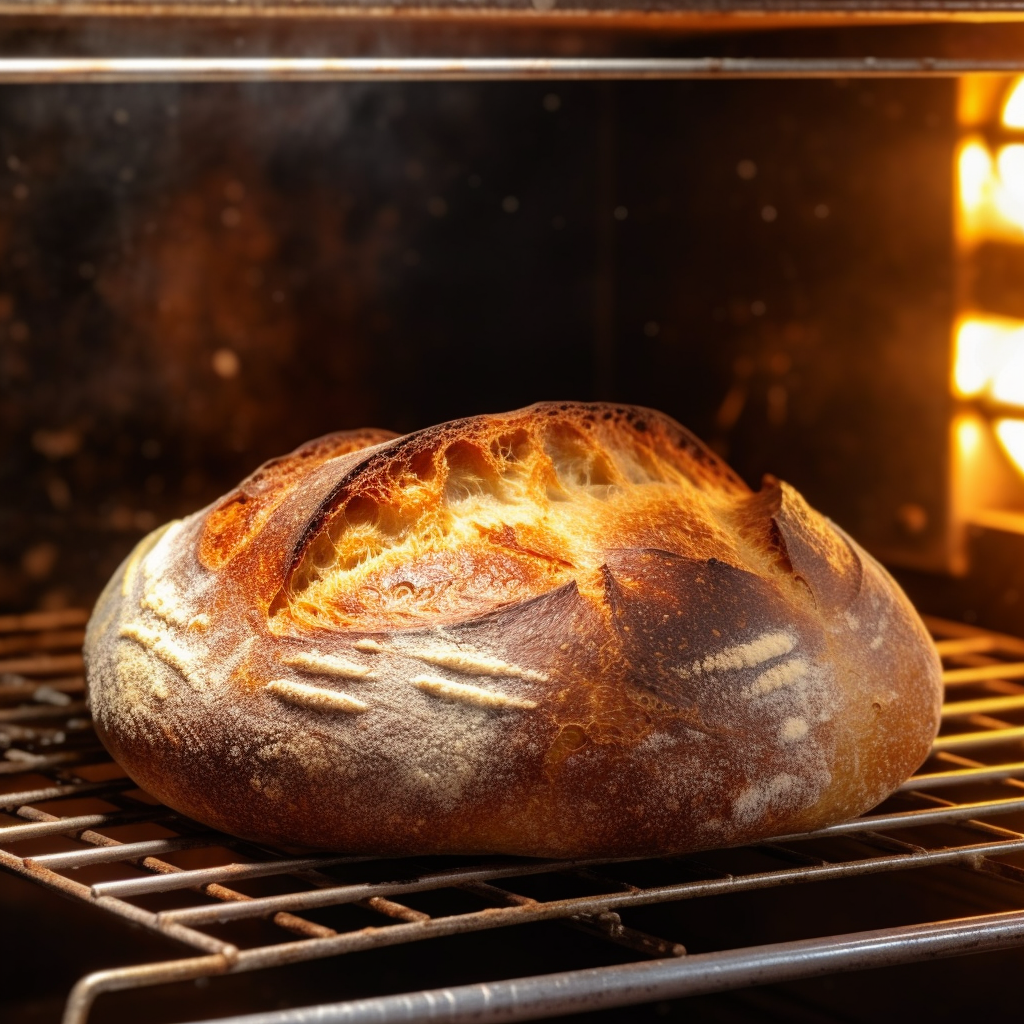
You’ve done everything right. Your starter was active, your bulk fermentation was on point, your shaping was clean. Then you baked the loaf and it came out pale, dense, or burnt on the outside with a raw center.
Nine times out of ten, that’s a temperature problem.
Baking temperature is the most underestimated variable in home sourdough baking. Most people set their oven to 450°F, wait for the preheat beep, and slide the loaf in. But oven temperature management is more nuanced than a single number — and understanding it will immediately improve your results.
Why Temperature Matters More Than Almost Anything Else
When your loaf hits the oven, three things happen at the same time — and each one needs different heat to work correctly.
Oven spring is the final burst of CO₂ from the yeast as the dough heats up rapidly. It only works if the oven is genuinely hot at the moment the bread goes in. A sluggish oven at the start means the crust sets before the loaf can fully expand — and that height is gone permanently.
Crust formation is the Maillard reaction — the same chemistry that browns a steak. It needs sustained high heat to produce that deep, crackling, caramelized crust. A pale loaf almost always means insufficient heat in the uncovered phase.
Interior baking is the crumb reaching an internal temperature of 205–210°F (96–99°C). If your crust develops faster than your interior bakes through, you end up with a loaf that looks perfect on the outside and is gummy in the middle.
These three processes don’t all need the same temperature. Managing heat across the bake — rather than keeping it constant — is what gives you the full package: strong oven spring, deep color, crisp crust, and a fully baked, open crumb.
Use the Calculator: Get Your Bake Temperature Plan
Before we go any further — if you want a stage-by-stage temperature and timing plan tailored to your actual loaf, vessel, oven, and crust preference, use this calculator. It accounts for loaf size, flour type, hydration, convection vs conventional, and whether you’re using a Dutch oven or going steamless.
Sourdough Bake Temperature & Timing Calculator
Tell the calculator about your loaf and oven — get a personalized stage-by-stage bake plan with preheat temps, covered and uncovered times, and internal temperature targets.
The Ideal Temperature Range
Most sourdough bakes use a starting temperature of 450–500°F (230–260°C).
The upper end of that range — 475–500°F — is better for larger boules where you want maximum oven spring before the crust sets. The lower end — 450–460°F — is more forgiving for smaller loaves or bakers whose ovens tend to run hot.
The single most important rule: Your oven must be genuinely preheated, not just to temperature on the dial. The difference matters more than most bakers realize.
The Preheat Problem
When your oven reaches the set temperature, the air inside is at that temperature. But the walls, floor, and any baking vessel inside are not — they take significantly longer to fully absorb and radiate heat.
A home oven that “finishes preheating” in 15 minutes has air at 450°F but oven walls and a Dutch oven that are still 50–75°F cooler than that. Bread baked in an underpreheated Dutch oven doesn’t get the initial blast of heat needed for strong oven spring.
The fix: Preheat for a minimum of 45–60 minutes, not 15–20. If you’re using a Dutch oven, it needs to be inside the oven during the entire preheat — placed on the center rack with the lid on before you ever turn the oven on.
This single change — extending your preheat — will visibly improve your oven spring on the next bake.
Use an oven thermometer. Most home ovens are inaccurate by 25–50°F, and some are off by more. A $10 oven thermometer tells you what your oven is actually doing, not what the dial says. If your oven runs cool, increase your set temperature to compensate. If it runs hot, lower it.
The Two-Stage Bake (And Why It Works)
The most effective approach to sourdough temperature isn’t a fixed setting — it’s two distinct phases that serve completely different purposes.
Stage 1: Covered at High Heat — Oven Spring
Temperature: 475–500°F (246–260°C) conventional / 450–475°F convection
Time: 18–25 minutes depending on loaf size
Lid: On
Baking with the Dutch oven lid on does two things simultaneously. It traps the steam the dough itself releases — keeping the surface moist and flexible so the loaf can expand fully before the crust sets hard. And it concentrates heat around the loaf, accelerating the oven spring process.
A crust that sets too early stops oven spring in its tracks. This is why bakers using a Dutch oven consistently get better rise than those baking on an open tray with no steam. After 20–25 minutes the loaf will have reached its maximum height. The interior is mostly baked through; the crust is set but still pale — exactly where you want it before moving on.
Stage 2: Uncovered at Lower Heat — Crust and Color
Temperature: 425–450°F (218–232°C)
Time: 15–25 minutes
Lid: Off
Remove the lid and drop the temperature slightly. This stage is entirely about crust development: color, thickness, and that crackling texture. Moisture escapes, the outer surface begins to caramelize, and the Maillard reaction does its work. The timing depends on how dark you want your crust — use it as a guide, but watch the loaf.
- 15 minutes: Light golden — thin, less crackly crust
- 20 minutes: Medium-deep amber — the classic sourdough look
- 25+ minutes: Dark mahogany — thick, intense crust with bold flavor
Optional Stage 3: Extended Low Bake for Extra-Thick Crust
Temperature: 400°F (200°C)
Time: 5–10 minutes
Oven door: Cracked open slightly
If you want a bakery-thick, shatteringly crisp crust — the kind that sings when you score it — this third stage dries the crust without continuing to cook the interior. Crack the oven door slightly and let the loaf sit at lower heat with some airflow. Optional, but worth trying once.