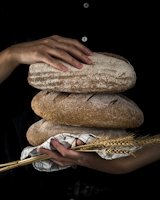
Ingredients
- 500 grams of whole grain flour
- 350 grams of water
- 10 grams of salt
- 150 grams of active sourdough starter
Instructions
- Mix the Dough: Combine the flour, water, and sourdough starter in a large bowl. Mix until no dry flour remains. Cover and let it rest for 30 minutes. This is your autolyse phase.
- Add Salt: Add the salt to the dough and knead it until the salt is fully incorporated.
- Bulk Fermentation: Let the dough rise in a warm place for about 4 to 6 hours, or until it has roughly doubled in size. The dough should be bubbly and light.
- Shape the Dough: After the dough has risen, gently turn it onto a lightly floured surface. Fold the dough onto itself, turning and folding, until it forms a tight ball. This creates tension on the surface of the dough which will help it hold its shape during the final rise.
- Final Proof: Place the shaped dough into a floured banneton (bread basket) or a bowl lined with a floured towel, cover it, and let it rise for another 2 to 4 hours, or until it passes the poke test (when a gently indented finger poke springs back slowly, but leaves a visible indent).
- Bake the Bread: Preheat your oven to 475°F (245°C). If you have a baking stone or Dutch oven, place it in the oven while preheating. Carefully turn the risen loaf onto a piece of parchment paper. Score the top of the loaf with a sharp knife or bread lame. Lower the heat to 450°F (232°C), and bake for 30 minutes with a cover (if using a Dutch oven) and then another 15-20 minutes uncovered, until the bread has a deep golden brown color and sounds hollow when tapped on the bottom.
Frequently Asked Questions
Q: How long does Ancient Sourdough Bread Recipe stay fresh?
You can store Ancient Sourdough Bread Recipe in an airtight container at room temperature for up to 3 days. For longer storage, freeze it in an airtight bag for up to 3 months. Thaw at room temperature before serving.
Q: Can I use active dry yeast instead of sourdough starter for Ancient Sourdough Bread Recipe?
This recipe is specifically developed to utilize the natural wild yeast in a sourdough starter. While you can technically substitute commercial yeast, it requires drastically altering the hydration levels and proofing times, which changes the authentic flavor profile.
Q: Why is my dough too sticky or hard to handle?
Sticky dough is incredibly common in sourdough baking. It is usually caused by either over-hydration (adding too much water for your flour's absorption capacity) or over-fermentation. If the dough is unmanageable, try reducing the liquid by 5-10% on your next bake, or perform an extra set of stretch and folds to build gluten strength.