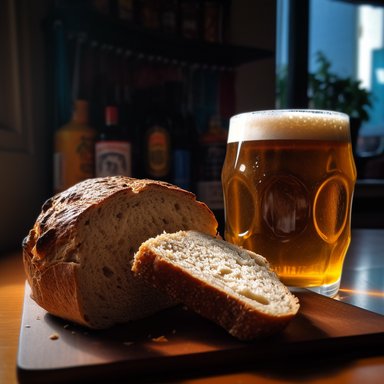
Ingredients
- 100 g active sourdough starter
- 300 g lukewarm beer
- 500 g bread flour
- 50 g whole grains
- 10 g salt
Instructions
- Mix your active sourdough starter with the lukewarm beer in a large bowl.
- Stir in the bread flour and whole grains until no dry spots remain.
- Cover and let sit at room temperature for about an hour. This rest period, or autolyse, helps the flour absorb the liquid and begins gluten development.
- Add the salt, then mix by hand until it’s fully incorporated into the dough.
- Perform a series of stretch and folds over the next 2-3 hours. To do this, wet your hand, then grab one side of the dough, stretch it up, and fold it over onto itself. Do this every 30 minutes to help build the dough’s strength and structure.
- After the stretch and fold process, let the dough rise until it has roughly doubled in size. The timing can vary depending on the temperature and the activity of your starter, but expect 4-8 hours.
- Once the dough has doubled, turn it out onto a lightly floured surface and shape it into a round loaf.
- Place the loaf into a well-floured proofing basket or bowl, cover, and let it rise until it’s puffy but still resilient. This could take 1-2 hours.
- Meanwhile, preheat your oven to 475F (245C) with a Dutch oven inside.
- Carefully transfer the risen dough into the preheated Dutch oven (be careful of the hot pot!). Score the top of the loaf with a sharp knife.
- Cover and bake for 30 minutes, then uncover and bake for another 15-20 minutes, until the loaf is deeply browned.
- Let the bread cool for at least an hour before slicing and serving.
Frequently Asked Questions
Q: How long does Beer and Wholegrain Sourdough Recipe stay fresh?
You can store Beer and Wholegrain Sourdough Recipe in an airtight container at room temperature for up to 3 days. For longer storage, freeze it in an airtight bag for up to 3 months. Thaw at room temperature before serving.
Q: Can I use active dry yeast instead of sourdough starter for Beer and Wholegrain Sourdough Recipe?
This recipe is specifically developed to utilize the natural wild yeast in a sourdough starter. While you can technically substitute commercial yeast, it requires drastically altering the hydration levels and proofing times, which changes the authentic flavor profile.
Q: Why is my dough too sticky or hard to handle?
Sticky dough is incredibly common in sourdough baking. It is usually caused by either over-hydration (adding too much water for your flour's absorption capacity) or over-fermentation. If the dough is unmanageable, try reducing the liquid by 5-10% on your next bake, or perform an extra set of stretch and folds to build gluten strength.