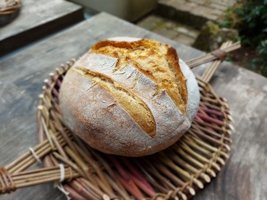
Ingredients
- 350 grams bread flour
- 100 grams active sourdough starter
- 220 grams water
- 8 grams salt
- For the butter layer:
- 150 grams unsalted butter
Instructions
- In a large mixing bowl, combine the bread flour, active sourdough starter, and water. Mix until all the ingredients are well incorporated.
- Cover the bowl with a clean kitchen towel and let it rest for 30 minutes. This resting period is known as the autolyse and helps improve gluten development.
- Sprinkle the salt evenly over the dough.
- Using wet hands, incorporate the salt into the dough by gently stretching and folding the dough over itself until the salt is fully integrated.
- Cover the bowl again and let it rest for 30 minutes.
- Perform a series of stretch and folds every 30 minutes for the next 2 to 3 hours. This helps develop the gluten and strengthen the dough.
- After each set of stretch and folds, cover the bowl and let the dough rest.
- Place the cool room temperature butter between two sheets of parchment paper.
- Using a rolling pin, gently flatten and roll out the butter into a rectangle that is approximately 8×10 inches.
- Place the flattened butter in the refrigerator to chill and firm up.
- On a lightly floured surface, roll out the dough into a rectangle that is slightly larger than the butter layer.
- Place the chilled butter layer onto the center of the dough rectangle.
- Fold the edges of the dough over the butter layer, sealing it completely.
- Roll out the dough and butter combination gently into a larger rectangle, about 1/4 inch thick.
- Perform a letter fold by folding one-third of the dough towards the center, then folding the other third over the top (similar to folding a letter).
- Rotate the dough 90 degrees and repeat the letter fold.
- Wrap the dough in plastic wrap and place it in the refrigerator to chill for at least 30 minutes.
- Remove the dough from the refrigerator and on a lightly floured surface, roll it out into a larger rectangle.
- Perform another set of letter folds as described in step 5.
- Repeat this rolling and folding process one more time, for a total of three sets of folds.
- After the final set of folds, shape the dough into a round or desired shape.
- Place the shaped dough into a proofing basket or a bowl lined with a well-floured cloth.
- Cover the dough and let it undergo its final proofing, which typically takes 4 to 6 hours. The dough should increase in volume and become visibly puffy.
- Preheat your oven to 450°F (230°C) and place a Dutch oven or a baking stone in the oven to preheat as well.
- Carefully transfer the proofed dough onto a piece of parchment paper.
- Score the top of the dough with a sharp knife or a bread lame.
- Remove the preheated Dutch oven or baking stone from the oven. Transfer the dough, along with the parchment paper, into the Dutch oven or onto the baking stone.
- Cover the Dutch oven with its lid or use a large oven-safe bowl to create a steamy environment.
- Bake for 20 minutes with the lid on (or covered with the bowl), then remove the lid and bake for an additional 20 minutes or until the bread is golden brown and has a hollow sound when tapped on the bottom.
- Remove the bread from the oven and let it cool on a wire rack before slicing and enjoying.
Frequently Asked Questions
Q: How long does Laminated Sourdough Bread Recipe stay fresh?
You can store Laminated Sourdough Bread Recipe in an airtight container at room temperature for up to 3 days. For longer storage, freeze it in an airtight bag for up to 3 months. Thaw at room temperature before serving.
Q: Can I use active dry yeast instead of sourdough starter for Laminated Sourdough Bread Recipe?
This recipe is specifically developed to utilize the natural wild yeast in a sourdough starter. While you can technically substitute commercial yeast, it requires drastically altering the hydration levels and proofing times, which changes the authentic flavor profile.
Q: Why is my dough too sticky or hard to handle?
Sticky dough is incredibly common in sourdough baking. It is usually caused by either over-hydration (adding too much water for your flour's absorption capacity) or over-fermentation. If the dough is unmanageable, try reducing the liquid by 5-10% on your next bake, or perform an extra set of stretch and folds to build gluten strength.