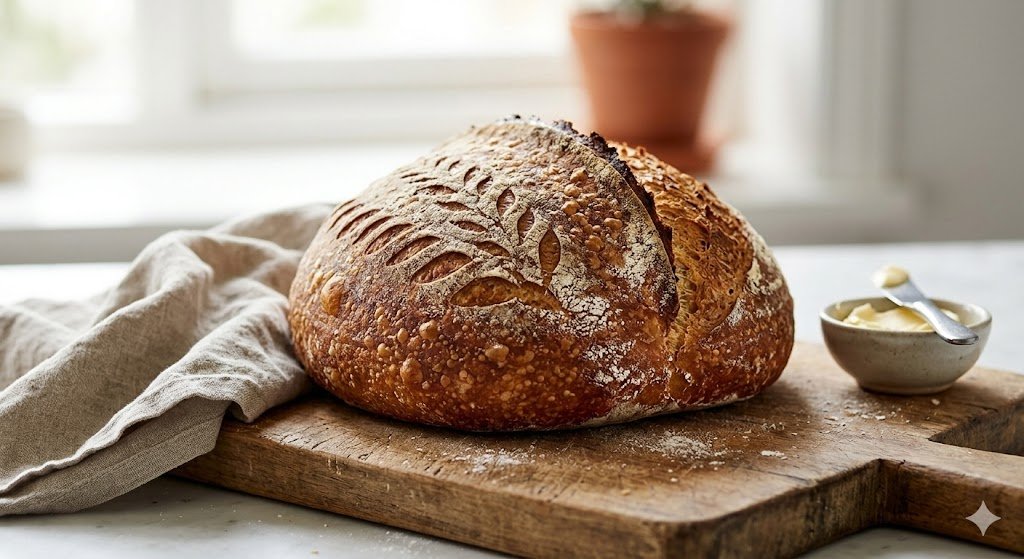
My first sourdough loaf was a flat, dense, gummy disaster. It looked like someone had sat on it. The crust was pale, the crumb was a solid brick, and I had spent the better part of two days convinced I was doing everything right.
I wasn’t.
If you’re about to bake your first sourdough loaf — or if you’ve already baked a few and they keep coming out wrong — this is the honest guide I wish someone had handed me before I started. Not the romanticized version. The real version, with all the things that actually trip beginners up and nobody warns you about.
Table of Contents
1. Your Starter Needs to Be Ready Before Anything Else
This sounds obvious, but it isn’t. Most beginners (myself included) read “feed your starter and wait a few hours” and assume that means it’s ready. It doesn’t.
A starter is ready to bake with when it has visibly doubled in size after feeding and is still domed at the top — not after it has peaked and started to fall. That window can be as short as an hour. If you mix your dough with a starter that’s underripe, overripe, or just sluggish, the rest of your efforts won’t matter much.
What to do: Put a rubber band around your jar right after feeding. Wait until the starter has risen to at least double the rubber band mark and still looks domed and bubbly. That’s your window. Bake then.
2. Temperature Controls Everything — And Your Kitchen Is Probably Too Cold
I spent months blaming my technique when the real culprit was my 67°F kitchen. Wild yeast is deeply temperature-sensitive. At 65°F or below, fermentation slows dramatically. At 75–80°F, it moves at the pace most recipes are written for.
If your starter is sluggish, your bulk fermentation seems to take forever, and your loaves are always dense — check your kitchen temperature before you change anything else.
What to do: Find the warmest spot in your kitchen. On top of the fridge is often 5–10°F warmer than the counter. Inside the oven with just the light on is another reliable option. A cheap thermometer takes the guesswork out entirely.
3. Time Ranges in Recipes Are Suggestions, Not Instructions
“Bulk ferment for 4–6 hours.” Okay, but at what temperature? With how active a starter? Made with what flour?
Every time range in a sourdough recipe assumes a specific set of conditions that may not match yours. The only way to know when bulk fermentation is actually done is to watch the dough, not the clock.
Bulk fermentation is done when:
- The dough has grown by 50–75%
- It looks airy and jiggly when you shake the bowl gently
- You can see bubbles on the sides and surface
- It feels lighter and more alive than when you started
What to do: Use the clock as a rough guide only. Trust what the dough is telling you more than what the recipe says.
4. Waiting to Cut the Loaf Is Not Optional
This was the hardest lesson to learn. After hours of work and the intoxicating smell of fresh bread, waiting another 2 hours to cut into it feels cruel.
But cutting too soon is one of the most common reasons for a gummy, wet crumb — even in a perfectly baked loaf. The inside of a sourdough loaf is still actively setting as it cools. Steam is releasing, starches are stabilizing, and the crumb is firming up. Cutting into it before that process is complete ruins the texture.
What to do: Set it on a wire rack. Walk away. Wait at least 1–2 hours. The bread will still be warm and the crumb will be dramatically better. This single habit will improve your results immediately.
5. A Dense Loaf Doesn’t Mean You Failed — It Means Something Specific Went Wrong
Dense sourdough has causes. It is not a judgment on your skill or patience. It means one of a short list of things:
- Your starter wasn’t active enough
- The dough was underproofed
- Your oven or Dutch oven wasn’t hot enough
- You used low-protein flour
Each of these has a direct fix. When a loaf comes out wrong, the goal isn’t to feel bad — it’s to identify the one variable that was off and change it on the next bake. Sourdough is a process of iteration, not perfection.
What to do: After each bake, eat the bread (even imperfect sourdough is usually good), and ask yourself one question: what’s the most likely thing that went wrong? Change one variable at a time. You’ll get there faster than you think.
6. Autolyse Is Worth the Extra 30 Minutes
Autolyse is just a fancy word for mixing your flour and water together and letting them sit before adding the starter and salt. It takes 30–60 minutes and costs you nothing. But the difference in dough texture is remarkable — the gluten develops on its own, the dough becomes smoother and more extensible, and shaping becomes significantly easier.
I skipped this step for months because it seemed fussy. Then I tried it and immediately understood why experienced bakers never skip it.
What to do: Mix flour and water together until no dry flour remains. Cover and rest for 30–60 minutes before adding your starter and salt. That’s it.
7. The Dutch Oven Is Not a Luxury — It’s the Secret
Sourdough baked in a Dutch oven and sourdough baked on a sheet pan are practically different breads. The Dutch oven does two things that are very hard to replicate otherwise: it traps steam from the dough itself during the first phase of baking (which keeps the crust soft and extensible so the loaf can rise), and it delivers intense, even heat from all sides.
Without a Dutch oven, you’re fighting against your oven to get a good crust and oven spring. With one, the process almost does itself.
What to do: Use a Dutch oven — any heavy, lidded pot that can handle 500°F will work. Preheat it in the oven for at least 45–60 minutes before baking. Bake covered for 20 minutes, then uncovered for 20–25 more.
8. Stretch and Fold Is Doing More Than You Think
During bulk fermentation, most recipes ask you to do a series of “stretch and folds” — pulling the dough up from one side and folding it over itself, rotating and repeating. It takes about 30 seconds per set and seems almost too simple to matter.
It matters a lot. Stretch and folds build gluten strength gradually over the course of the bulk ferment, align the gluten structure, and incorporate air. Skipping them means you arrive at shaping with weak, slack dough that’s hard to work with and prone to spreading.
What to do: Do 4–6 sets of stretch and folds spaced 30 minutes apart during the first 2–3 hours of bulk fermentation. After each set, you’ll notice the dough getting noticeably stronger and more elastic.
9. Shaping Is a Skill — And the First Few Times Will Be Rough
Shaping sourdough takes practice, and the first time you try to shape a sticky, airy mass of dough into a taut, smooth ball, it will probably not go well. That’s completely normal.
The goal of shaping isn’t to make the dough look pretty — it’s to create surface tension. That tension holds the loaf upright during baking and helps it rise up instead of spreading sideways. A well-shaped loaf feels firm and springy; a poorly shaped one feels soft and slack.
What to do: Watch a few videos of shaping technique before you try it — it’s much easier to understand visually than in text. Shape on an unfloured or very lightly floured surface so the dough has friction to work against. Use a bench scraper. Expect the first few attempts to be messy and improve from there.
10. Bad Bread Is Still Good Bread
Even a flat, dense, gummy sourdough loaf — the worst-case scenario — is still sourdough bread. It still has that distinctive tang. It still makes good toast. It’s still something you made from flour, water, salt, and a wild yeast culture you cultivated yourself.
Every imperfect loaf is teaching you something. The bakers who make consistently beautiful sourdough didn’t start out that way — they baked through their bad loaves until the good ones came.
Don’t let the pursuit of a perfect crumb steal the satisfaction of the process. You’re learning one of the oldest food crafts in human history. Give yourself permission to be a beginner.
The Beginner’s Cheat Sheet
Before your first (or next) loaf, keep these in mind:
- Starter: Only use it when it has doubled after feeding and is still domed — not before, not after it falls
- Temperature: Aim for 75–80°F during fermentation; cold kitchens are the silent killer of sourdough
- Timing: Use time ranges as a guide; trust what the dough looks and feels like
- Shaping: Build tension — dough should feel taut and springy after shaping
- Baking: Preheat the Dutch oven for 45–60 minutes; bake covered then uncovered
- Cooling: Wait at least 2 hours before cutting. Every time. Non-negotiable.
Frequently Asked Questions
How long does it take to get good at sourdough? Most bakers feel genuinely confident after 8–12 loaves. The first 3–4 are about learning the basics; the next few are about dialing in your specific kitchen conditions, flour, and starter. By loaf 10 or so, it starts to feel intuitive.
Do I need a kitchen scale? Yes. Sourdough baking by weight rather than volume is dramatically more consistent. Flour especially varies wildly by volume depending on how it’s scooped. A basic digital scale costs very little and makes an immediate difference.
What’s the best flour for a first loaf? A high-quality bread flour (12–13% protein or higher) gives you the most forgiving, reliable results. King Arthur Bread Flour is a consistently strong choice. Save the whole wheat and high-hydration experiments for after you’ve got a few solid loaves under your belt.
Can I make sourdough without a Dutch oven? Yes, but it’s harder. You’ll need to create steam another way — a tray of boiling water placed in the oven when the bread goes in, or ice cubes thrown onto the oven floor. Results will be less consistent until you develop more experience.
My bread looked perfect but tasted bland — what happened? Usually one of two things: your starter isn’t sour enough yet (young starters are milder), or your bulk fermentation was too short. Longer, cooler fermentation develops more complex flavor. Try fermenting in the fridge overnight instead of at room temperature.
Bottom Line
Sourdough has a reputation for being difficult, and honestly, the first few loaves can be humbling. But every problem has a cause, and every cause has a fix. The bakers who succeed are the ones who treat each loaf as data, not judgment.
Start with an active starter, keep your kitchen warm, watch the dough instead of the clock, and let your loaf cool before you cut it. Those four things alone will put you ahead of where most beginners start.
The rest comes with practice.
Now that you know what to watch for, here are the guides to bookmark: