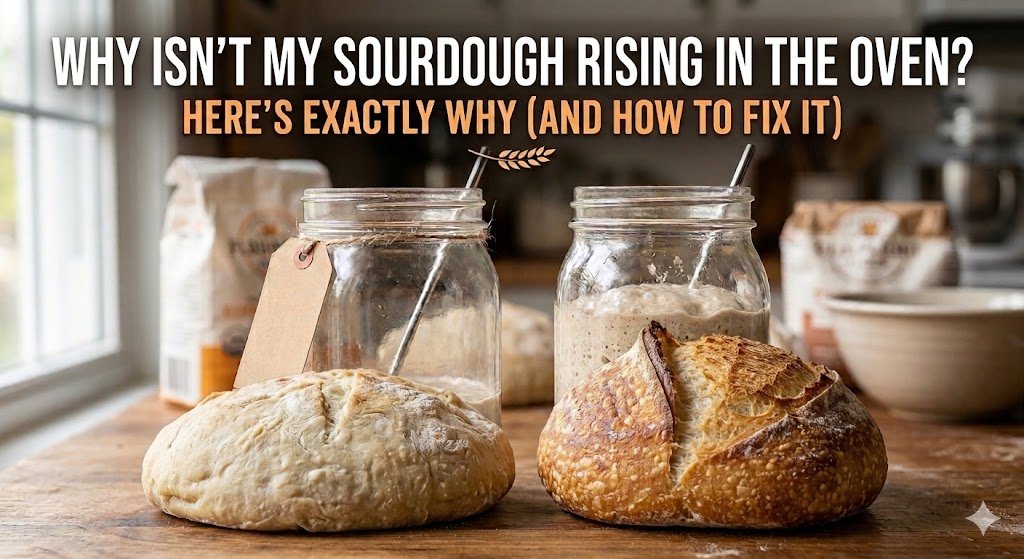
You shaped your dough, proofed it overnight, and slid it into a screaming hot Dutch oven. But when you lifted the lid halfway through baking, the loaf was flat. No dramatic rise. No beautiful ear. Just a dense, disc-shaped disappointment.
If your sourdough isn’t rising in the oven, the problem is almost always rooted in one of a handful of fixable causes. Oven spring — that dramatic rise in the first 15–20 minutes of baking — is the payoff for everything you did beforehand. When it doesn’t happen, something earlier in the process went wrong.
This guide explains exactly why sourdough fails to rise in the oven, how to figure out which issue is yours, and what to change on your next bake.
Table of Contents
What Is Oven Spring and Why Does It Happen?
Oven spring is the rapid rise that happens in the first 10–20 minutes of baking, before the crust sets. It’s caused by a combination of things happening simultaneously:
- The heat activates any remaining yeast activity for one last burst of gas production
- The gases already trapped in the dough expand rapidly with the heat
- Steam keeps the crust soft and extensible long enough for the loaf to expand before it hardens
A well-made sourdough loaf can increase by 25–50% in volume during oven spring. When this doesn’t happen, the loaf bakes into whatever shape and size it entered the oven — and the crumb is usually dense and tight.
Quick Diagnosis: Why Isn’t My Sourdough Rising in the Oven?
| What You See | Most Likely Cause |
|---|---|
| Flat loaf, dense crumb, no ear | Underproofed or weak starter |
| Loaf spreads sideways instead of up | Overproofed or dough too wet |
| Rises a little but nothing dramatic | Dutch oven not hot enough / no steam |
| Uneven rise, bursts on the side | Underscored or scored at wrong angle |
| Used to rise, recently stopped | Temperature change or different flour |
| Flat and pale crust | Oven temperature too low |
7 Reasons Your Sourdough Isn’t Getting Oven Spring
1. Your Starter Wasn’t Active Enough
Oven spring relies on live, active yeast in the dough. If your starter wasn’t at peak activity when you mixed the dough — if it was overripe, underripe, or just sluggish — there simply isn’t enough yeast in the dough to produce the gas needed for a strong rise. Use the Sourdough Starter Feeding Calculator to nail your feeding ratios and set your starter up for peak activity.
This is the foundational issue. Everything else in this list matters, but none of it will save a loaf made with a weak starter.
Signs this is your problem:
- Your starter doesn’t reliably double within 4–8 hours of feeding
- You used your starter straight from the fridge without refreshing it
- Your starter is less than 2 weeks old
The fix:
- Only bake with starter that has doubled (or more) within 4–8 hours of feeding at room temperature
- Feed your starter 1–2 times before baking to make sure it’s truly active
- Do the float test: drop a teaspoon into water — if it floats, it’s ready
2. The Dough Is Underproofed
This is the single most common cause of poor oven spring. An underproofed dough hasn’t developed enough gas bubbles or gluten extensibility to expand in the oven. The tight, underdeveloped gluten resists the pressure trying to push it outward, and the loaf stays flat and dense. The Fermentation Matrix predicts your bulk fermentation window based on your kitchen temperature and starter strength — so you know exactly when your dough is ready.
Confusingly, underproofed loaves can look fine going into the oven — they hold their shape, they feel taut. But they won’t rise.
Signs of underproofing:
- The scored dough springs back immediately when poked (not slowly)
- Very little oven spring, dense crumb
- The crust tears or bursts at the seam rather than along the score line
- The loaf feels very tight and firm going into the oven
The fix:
- Use the poke test: shaped dough should spring back slowly and incompletely when poked with a floured finger. Immediate spring-back = needs more time.
- Give your bulk fermentation more time — it’s done when the dough has grown by 50–75% and looks jiggly and airy, with bubbles visible on the sides.
- In cold kitchens, bulk fermentation can take 10–14 hours. Don’t go by the clock — go by the dough.
3. The Dough Is Overproofed
Overproofing is underproofing’s less obvious sibling. When dough ferments too long, the gluten network weakens and can no longer hold gas under pressure. Instead of rising in the oven, the structure collapses and the loaf spreads outward.
An overproofed loaf often looks beautiful going in — domed, pillowy, soft. But in the oven, it deflates rather than rises.
Signs of overproofing:
- The dough feels very slack and jiggly — almost like a water balloon
- It spreads wide and flat in the oven rather than rising
- The crumb has large, irregular holes with dense, gummy patches
- Poke test: the indent doesn’t spring back at all
The fix:
- End bulk fermentation earlier — when the dough has grown 50–75%, not doubled or more
- In warm weather, fermentation happens much faster; shorten your timings in summer
- Bake straight from the fridge after an overnight cold retard — the cold firms the dough and makes it easier to score and handle
4. Your Dutch Oven Wasn’t Hot Enough
Steam and intense bottom heat in the first phase of baking are critical for oven spring. If your Dutch oven hasn’t been preheating long enough, two things go wrong: the crust starts to set before the loaf has fully expanded, and the base doesn’t get the immediate blast of heat needed to trigger rapid rise.
Many bakers preheat their oven for 20–30 minutes and assume the Dutch oven is ready. It isn’t. Cast iron takes significantly longer to reach true temperature.
The fix:
- Preheat your Dutch oven in the oven for at least 45–60 minutes before baking
- Set your oven to 475–500°F (245–260°C) — this is higher than you might think is necessary, but the temperature drops when you open the door and add cold dough
- If you don’t have a Dutch oven, bake on a preheated baking stone or steel with a tray of ice placed in the bottom of the oven to create steam
5. You Didn’t Score the Dough (or Scored It Wrong)
Scoring isn’t just decorative. When you cut into the surface of the dough, you’re creating a controlled weak point where the loaf can expand freely. Without a score — or with a score that’s too shallow, too timid, or at the wrong angle — the crust seals over quickly and traps the gas inside, preventing the loaf from rising.
The fix:
- Use a sharp lame or a razor blade — a dull blade drags and deflates the dough instead of cutting cleanly
- Score confidently and quickly in one fluid motion; hesitating causes tearing
- Score at a 30–45 degree angle to the surface (almost parallel), not straight down — this creates the flap of dough that becomes the ear
- Score at least ½ inch deep; shallow scores seal shut in the oven heat
6. Your Oven Temperature Is Too Low
Home ovens are notoriously inaccurate. An oven set to 450°F can easily be running at 400°F or lower, especially if it hasn’t been calibrated recently or if you opened the door to check on something. A low oven temperature means slower heat transfer, which allows the crust to set before the full oven spring can happen. Use the Baking Temperature & Time Calculator to get stage-by-stage baking guidance for your setup.
The fix:
- Buy an oven thermometer — it’s one of the cheapest, most valuable baking tools there is
- If your oven runs cool, compensate by setting it 25–50°F higher than the recipe states
- Avoid opening the oven door in the first 20 minutes of baking — every time you open it, you lose significant heat and steam
7. The Dough Was Too Cold (or Too Warm) Coming Out of the Fridge
Most bakers cold-proof their shaped dough overnight in the fridge and bake it straight from cold — this is actually ideal, because cold dough holds its shape better, scores more cleanly, and often produces better oven spring because it has more room to rise before the crust sets.
However, if your dough is too cold (below 35°F, perhaps near a freezer vent), the yeast activity is almost completely suppressed and the dough may need more time to warm up before it can spring.
The fix:
- Cold-proof in the main body of the fridge, not near the freezer or on the coldest shelf
- Bake straight from the fridge — you don’t need to bring it to room temperature first
- If you suspect the dough got too cold, let it sit on the counter for 15–20 minutes before baking
How to Maximize Oven Spring Every Time
These practices consistently produce the best oven spring:
Use a Dutch oven. The enclosed environment traps steam from the dough itself, keeping the crust soft and extensible during the critical first phase of baking.
Bake covered for 20 minutes, uncovered for 20–25 more. The covered phase is for rise; the uncovered phase is for crust development and color.
Score cold dough. Dough straight from the fridge is firm and much easier to score cleanly. A clean score = better ear = better spring.
Preheat longer than you think you need to. 45–60 minutes for the Dutch oven. More is better.
Don’t over-flour your dough. Excess flour on the surface creates a dry skin that resists expansion. Use just enough to prevent sticking.
The Oven Spring Checklist
Run through this before every bake:
- Starter doubled within 4–8 hours of feeding before mixing
- Bulk fermentation ended at 50–75% growth, dough looks airy and jiggly
- Shaped dough passed the poke test before going in the oven
- Dutch oven preheated for 45–60 minutes at 475–500°F
- Scored quickly and confidently at a 30–45 degree angle, at least ½ inch deep
- Did not open oven door in the first 20 minutes
- Baked covered for 20 minutes, then uncovered for 20–25 more
Frequently Asked Questions
Why did my sourdough have great oven spring before but not now? The most likely culprits are a change in temperature (seasons shifting), a new bag of flour, or a starter that’s become sluggish from irregular feedings. Check each variable one at a time to isolate the issue.
Can I get oven spring without a Dutch oven? Yes, but it’s harder. You need to generate steam another way — a tray of boiling water on the lower rack, or a handful of ice cubes thrown onto the oven floor when the bread goes in. A baking stone or steel helps deliver bottom heat.
How do I know if it’s underproofed vs. overproofed? The poke test is the most reliable way to tell in real time. After baking, underproofed loaves have a tight, compact crumb and often a gummy center. Overproofed loaves have a coarser, uneven crumb with a collapsed, flat shape and sometimes a pale, thick crust.
Does the type of flour affect oven spring? Yes. Bread flour has more protein than all-purpose, which means stronger gluten development and better capacity to trap gas and rise. If you’ve been using all-purpose flour and getting flat loaves, trying bread flour is an easy fix worth attempting.
Why does my sourdough rise and then deflate in the oven? This is almost always overproofing. The gluten structure is too weak to hold the gas as it expands under heat, and the loaf collapses. Shorten your bulk fermentation time and bake earlier.
Bottom Line
Oven spring failure usually points back to one of three things: starter strength, proofing time, or heat. Start by confirming your starter is truly active, then check your proofing with the poke test, and make sure your Dutch oven has been preheating long enough.
None of these fixes require new equipment or different recipes — just small adjustments to timing and technique. Once the pieces click into place, that dramatic oven spring becomes the most satisfying part of the whole process.
Still troubleshooting? You might also find these helpful:
- Sourdough Starter Not Rising? Here’s Exactly Why (And How to Fix It)
- Why Is My Sourdough Gummy Inside?
- Easy Sourdough Recipe With Starter
Plan your entire bake schedule — including proofing time — with the free Bake Planner: