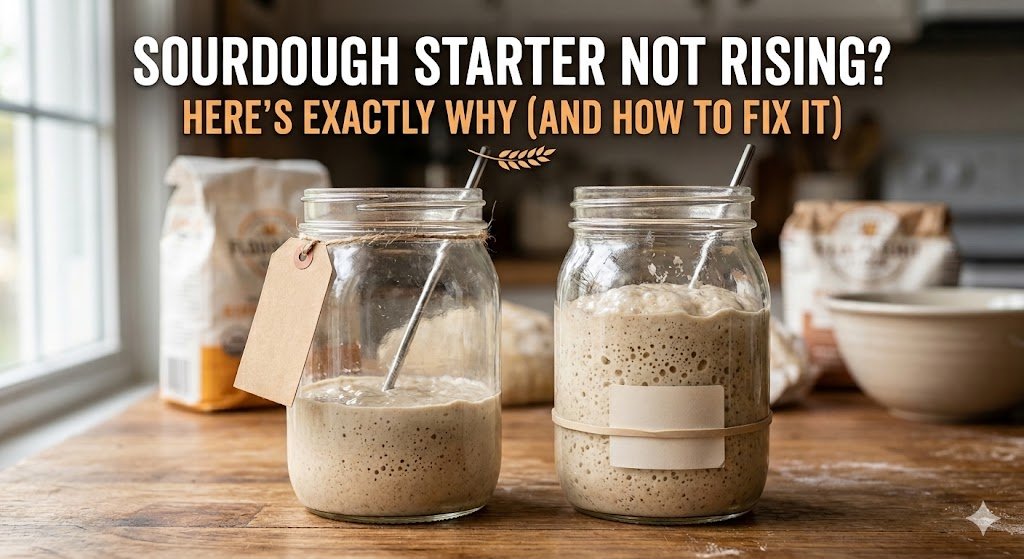
You fed your starter, set it on the counter, and waited. And waited. And… nothing. If your sourdough starter is not rising, you’re not alone — it’s one of the most common frustrations new bakers run into, and it almost always has a fixable cause.
The good news: a starter that isn’t rising isn’t a dead starter. In most cases, it just needs a small adjustment to get back on track.
This guide walks you through every likely reason your sourdough starter isn’t rising, how to diagnose the real problem, and exactly what to do to fix it.
Table of Contents
First: What Does a Healthy, Active Starter Actually Look Like?
Before troubleshooting, it helps to know what you’re aiming for. A healthy, active sourdough starter will:
- Double in size (or more) within 4–8 hours of feeding at room temperature
- Have visible bubbles throughout, not just on the surface
- Smell pleasantly sour — tangy, a little yeasty, sometimes fruity
- Have a domed top at peak rise, then begin to fall and look slightly deflated
If your starter isn’t doing this, keep reading.
Quick Diagnosis: Why Is My Sourdough Starter Not Rising?
| Symptom | Most Likely Cause |
|---|---|
| No bubbles at all, no activity | Too cold, or starter is very new |
| Tiny bubbles but no rise | Weak culture, needs more feedings |
| Rises a little then stops | Correct — it may have peaked and fallen |
| Smells like nail polish remover | Hooch — needs feeding more frequently |
| Smells bad (not sour — rotten) | Possible contamination |
| Used to rise but suddenly stopped | Temperature change or different flour |
7 Reasons Your Sourdough Starter Isn’t Rising
1. It’s Too Cold
This is the #1 reason starters fail to rise, especially in winter or in air-conditioned kitchens. Wild yeast is highly temperature-sensitive. Below about 65°F (18°C), fermentation slows to a crawl. Below 50°F, it nearly stops. Check the Sourdough Fermentation Matrix to see how temperature directly affects your fermentation timeline.
How to fix it:
- Find a warmer spot — on top of the fridge, near (not on) a warm oven, or inside the oven with just the light on
- Aim for 75–80°F (24–27°C) for the most reliable rise
- Use a thermometer to check your actual counter temperature — kitchens are often cooler than you think
Quick test: If your starter is sluggish, move it somewhere warmer and wait 2 hours. If bubbles appear, temperature was your problem.
2. Your Starter Is Too New
A brand new starter — one that’s less than 7–14 days old — often won’t rise reliably yet. In the early days, you’re cultivating a wild yeast culture from scratch. The first week is typically characterized by wild, unpredictable activity as different microorganisms compete for dominance before the good bacteria win out.
What you’ll see: A very new starter may have some bubbles and even rise a little in the first few days, then seem to go quiet for a few days. This is completely normal and called the “lag phase.”
How to fix it:
- Keep feeding once or twice daily with consistent flour and water
- Be patient — most starters become reliably active by day 10–14
- Use whole wheat or rye flour for early feedings; they contain more wild yeast and minerals to jumpstart activity
3. You’re Using the Wrong Flour (or Changed Flours)
All-purpose flour works fine for a mature starter, but it’s not ideal for building a new one or for reviving a sluggish one. Bleached all-purpose flour in particular can inhibit yeast activity because the bleaching agents interfere with fermentation.
How to fix it:
- Switch to unbleached all-purpose flour
- Try substituting 20–30% of your flour with whole wheat or rye flour — even just a tablespoon of rye makes a noticeable difference
- If you recently switched flour brands and your starter slowed down, switch back or give it a few days to adjust
4. Your Water Is Killing the Yeast
Heavily chlorinated tap water can inhibit or slow yeast activity. Most municipal tap water contains chlorine or chloramine, which are added to kill microorganisms — and your starter is full of microorganisms.
How to fix it:
- Use filtered water, or let tap water sit uncovered on the counter for 1–2 hours before using (this allows chlorine to off-gas — note this does not remove chloramine)
- Room temperature water works best; avoid cold water straight from the tap, which can slow fermentation
5. Your Ratios Are Off
When you feed your starter, the ratio of starter to fresh flour and water matters. If you feed with too much flour relative to the amount of starter, the yeast gets diluted and has to work harder to leaven the whole mixture. A very stiff starter (not enough water) can also ferment more slowly. The free Sourdough Starter Feeding Calculator takes the guesswork out — just enter your amounts and get the right ratios instantly.
The standard feeding ratio: 1:1:1 — 1 part starter : 1 part flour : 1 part water (by weight)
For a sluggish starter, try a 1:2:2 ratio (1 part starter to 2 parts each flour and water) to give it a smaller amount of new food to work through.
How to fix it:
- Weigh your ingredients rather than measuring by volume for consistency
- Stick to the same ratio every feeding until your starter stabilizes
6. You’re Missing the Peak — It Rose and Fell While You Weren’t Watching
Many new bakers think their starter isn’t rising because by the time they check it, it has already peaked and collapsed. A starter at 75°F can rise and fall in as little as 4–6 hours.
Signs this is happening:
- A “high water mark” or ring on the inside of your jar from where the starter was
- A sticky residue on the lid if you’re using one
- The starter looks slightly deflated and starting to separate
How to fix it:
- Put a rubber band around the jar right after feeding and track how high it rises
- Check every 2 hours after feeding for a full day to map your starter’s rhythm
- A starter used for baking should be used at peak — when it’s domed and at its maximum height
7. It Needs a Feeding Refresh
If your starter has been sitting in the fridge and hasn’t been fed in weeks, or if it’s been on the counter without feeding for too long, it may have exhausted its food supply and become too acidic for the yeast to thrive. This is when you’ll often see a grey liquid on top (called “hooch”) — it’s not harmful, but it’s a sign your starter is hungry.
How to fix it:
- Pour off most of the starter, leaving just 20–30g
- Feed with fresh flour and water (1:1:1 ratio)
- Repeat this once or twice daily for 3–5 days
- Keep it at warm room temperature (not in the fridge) during this revival period
The 3-Day Starter Revival Plan
If your starter has been neglected or you’re not sure what’s wrong, this simple 3-day refresh works in most cases:
Day 1 (Morning): Discard all but 20g of starter. Feed with 40g unbleached flour (or a mix of all-purpose and rye) and 40g room-temperature filtered water. Leave at 75–80°F.
Day 1 (Evening): Repeat the same feeding.
Day 2: Feed twice again, same ratios. You should start to see more bubbles and some rise by the second day.
Day 3: Feed in the morning. By afternoon, your starter should be visibly active. Test it with the float test (see below) before baking.
How to Know When Your Starter Is Ready to Use
The Float Test
Drop a small spoonful of starter into a glass of water. If it floats, it’s full of gas bubbles and ready to bake with. If it sinks, give it more time.
The Doubling Test
Mark the level after feeding with a rubber band or tape. If it doubles within 4–8 hours, it’s active and ready.
The Smell Test
An active starter smells pleasantly tangy and yeasty — a little like yogurt or beer. If it smells like nail polish remover, it needs feeding. If it smells truly rotten, something else may be wrong.
When Should You Give Up and Start Over?
Rarely. A starter showing any activity at all — even just a few bubbles — is worth saving. The only time it makes sense to start fresh is if there’s visible pink, orange, or fuzzy mold on the surface, which indicates contamination. Even then, you can sometimes scrape the affected part away and save the rest.
A grey liquid, a strong smell, or no activity are all fixable problems. Don’t throw it out — just feed it.
Frequently Asked Questions
How long does it take for a sourdough starter to rise after feeding? At 75–80°F, an active starter typically doubles within 4–8 hours of feeding. In cooler temperatures it can take 10–12 hours or longer.
Can I use my starter if it hasn’t doubled? Technically yes, but the results will be less predictable. For the best bread, wait until your starter has at least doubled and passes the float test.
My starter bubbles but doesn’t rise — what’s wrong? This usually means the culture is somewhat active but not strong enough yet. Continue daily feedings at a consistent temperature. Adding a tablespoon of rye flour can help accelerate activity.
Should I stir my starter after feeding? Yes — give it a good stir to incorporate air and mix the flour and water evenly. Some bakers stir again halfway through the rise.
Is it okay if my starter smells really sour? A strong sour smell just means it’s overripe and needs feeding — it won’t harm the starter. Feed it and let it rise again before using.
Bottom Line
A sourdough starter not rising is almost never a death sentence for your starter. In the vast majority of cases, the fix is one of these five things: warmer temperature, more frequent feedings, better water, different flour, or simply more time.
Give your starter consistent care — same time each day, same ratios, same warm spot — and within a few days you’ll almost certainly see it come to life.
Feeling more confident about your starter? Next up: Easy Sourdough Recipe With Starter — once your starter is active and ready, this is the perfect first loaf to bake.
Take the guesswork out of starter ratios with the free calculator:
Sourdough Starter Feeding Calculator → | Fermentation Timing Matrix →